
Solheim Cup Trophy: Design, Maker and the Story Behind It
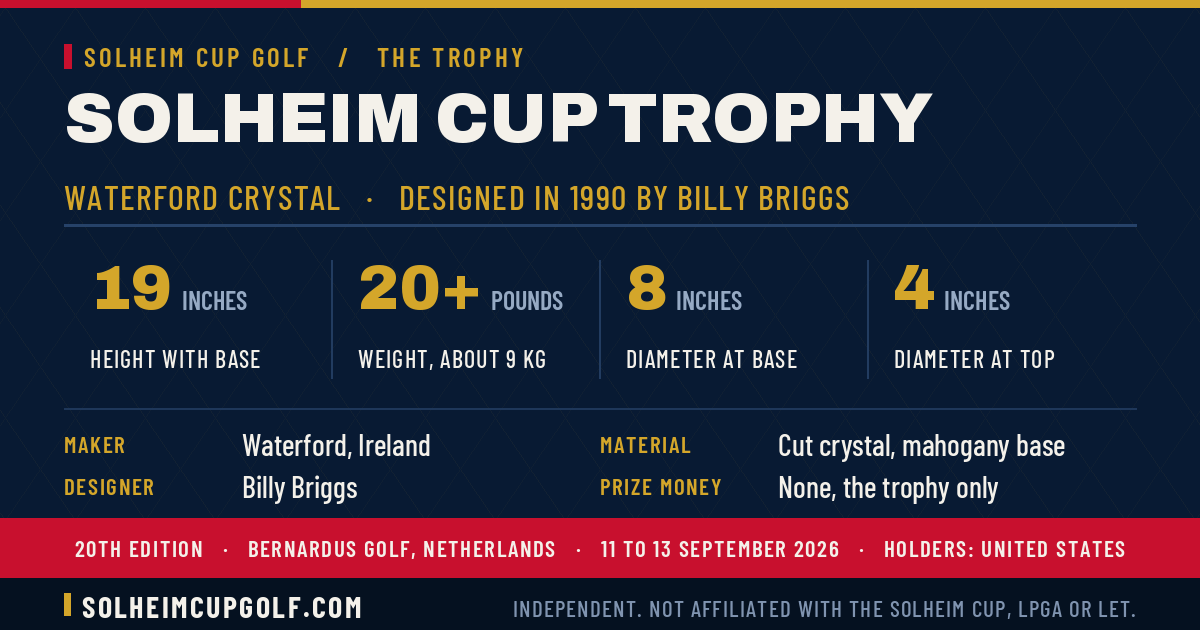
The Solheim Cup trophy is cut Irish crystal made by Waterford and designed in 1990 by Billy Briggs. It stands 19 inches tall on a mahogany base, weighs more than 20 pounds and carries no prize money at all. The winning team keeps it for two years. The United States hold it now, and it is back on the line at Bernardus Golf from 11 to 13 September 2026.
Jump to: Specifications | How it is made | Karsten Solheim | Why that name | What the winners get | Where it goes in 2026 | FAQ
Solheim Cup Trophy Specifications
| Detail | Specification |
|---|---|
| Maker | Waterford, Ireland |
| Designer | Billy Briggs |
| Year designed | 1990 |
| Material | Cut crystal on a mahogany base |
| Height with base | 19 inches |
| Diameter at the base | 8 inches |
| Diameter at the top | 4 inches |
| Weight | More than 20 pounds, roughly 9 kg |
| Prize money attached | None |
| Current holder | United States, 15.5 to 12.5 in 2024 |
Twenty pounds of solid crystal is why you usually see the winning captain lift it with both hands. Since 2024 it has travelled in a custom Tumi 19 Degree aluminium case. Waterford has put the value of the piece at more than 50,000 dollars.
How the Solheim Cup Trophy Is Made
The Waterford Glass House was founded on 3 October 1783 by brothers George and William Penrose. The original works closed in 1851 and crystal making was revived in Waterford in 1947. The modern company was commissioned to craft the trophy when the match was created, and Billy Briggs, one of its senior designers, drew it in 1990.
Three crafts go into it: blowing, cutting and engraving. The deeply incised patterns are what make it flash under the lights on presentation day.
The centre panel carries an intaglio engraving of the Solheim Cup logo, cut with a technique Waterford says has hardly changed since the Middle Ages. That logo is itself a drawing of the trophy, so the cup shows a picture of itself.
Each result is recorded on a plate set into the mahogany base: winning team, score and host course. The base was built to grow taller as those plates are added, which means the trophy is not quite the same object it was in 1990.
Only one exists, so it never stays in one place for long. A smaller replica sits permanently in Nicklaus Hall at Muirfield Village Golf Club in Ohio, which hosted the 1998 match.
Who Was Karsten Solheim?
| Born | 15 September 1911, Bergen, Norway |
| Died | 16 February 2000, Phoenix, Arizona |
| Company | Karsten Manufacturing Corporation, founded 1967, maker of PING |
| Known for | The PING Anser putter and the Solheim Cup |
| Hall of fame | World Golf Hall of Fame, 2001, lifetime achievement |
Karsten Solheim was an engineer at General Electric, not a golfer by trade. Colleagues invited him to make up a foursome in 1954, when he was 42, and he could not putt. So he designed his own, testing the idea at home with sugar cubes and popsicle sticks.
His change was simple and it altered club design permanently. Instead of joining the shaft at the heel of the blade, he joined it near the centre and pushed the weight out to the perimeter. The first putter, the PING 1A, came out of his garage in 1959.
The Anser followed in 1966. The breakthrough came in early 1967, when Julius Boros won the Phoenix Open with one. Demand jumped, Solheim resigned from GE that year and set up Karsten Manufacturing Corporation.
He backed women’s golf long before the Solheim Cup existed. He and Louise began sponsoring LPGA Tour events in 1975, and PING is still a global partner and official apparel supplier to the match.
Why It Is Called the Solheim Cup
The match is named after Karsten and his wife Louise Solheim, not after a sponsor. Louise ran the administrative side of the company from the garage years onward. She also named the Anser putter: she suggested “Answer”, because it answered the problems of putting, and it was shortened to fit the trademark. She died on 8 July 2017, aged 99.
The family funded and drove the idea of a women’s team match to sit alongside the Ryder Cup. The first edition was played in 1990 at Lake Nona Golf and Country Club in Florida, where Kathy Whitworth’s American side won 11.5 to 4.5.
Karsten died in February 2000, ten years after that first match. It has been played every two years since, and 2026 is the 20th edition.
What the Winning Team Actually Gets
The trophy, and nothing else. The winning side holds it for two years, then hands it back before the next edition.
There is no cheque. No player, captain or vice captain is paid to compete, and no world ranking points are awarded. The reasons are covered on our Solheim Cup prize money page.
One rule decides a drawn match. The Cup stays with the defending team, which is how Europe kept it in 2023 after the only tie in the event’s history, 14 to 14 at Finca Cortesin.
Where the Solheim Cup Trophy Goes in 2026
The 20th Solheim Cup is at Bernardus Golf in Cromvoirt, in the Dutch province of North Brabant. The event week runs from 7 September and the matches are played from 11 to 13 September 2026. It is the first time the Solheim Cup has been staged in the Netherlands.
Twenty eight points are on offer across three days. Europe, captained by Anna Nordqvist, need 14.5 points to take the trophy back. The United States, under Angela Stanford, need only 14, because a tie leaves it with the holder.
See who is playing for it on the Solheim Cup 2026 teams page, or check the full schedule and tee times.
Solheim Cup Trophy FAQ
What is the Solheim Cup trophy made of?
Cut Irish crystal made by Waterford, mounted on a mahogany base. It stands 19 inches tall and weighs more than 20 pounds, roughly 9 kg.
Who designed the Solheim Cup trophy?
Billy Briggs, one of Waterford’s senior designers, in 1990. Waterford has crafted the trophy since the first edition. The original Waterford Glass House was founded in 1783 by brothers George and William Penrose.
How tall is the Solheim Cup trophy and how heavy is it?
It is 19 inches tall including the base, 8 inches across the base and 4 inches across the top. It weighs more than 20 pounds, which is why it is usually lifted with both hands.
Who is the Solheim Cup named after?
Karsten and Louise Solheim. Karsten was a Norwegian born engineer who founded Karsten Manufacturing, the company behind PING golf clubs, and drove the creation of a women’s team match to sit alongside the Ryder Cup. Louise ran the business side and named the Anser putter.
Does the Solheim Cup winner get any money?
No. The winning team receives the trophy and nothing financial. There is no purse, no winner’s cheque and no payment to players, captains or vice captains. No world ranking points are awarded either.
Who keeps the Solheim Cup trophy if the match is tied?
The defending team keeps it. That is how Europe retained the Cup after the 14 to 14 tie at Finca Cortesin in 2023, the only drawn match in the event’s history. In 2026 that rule works for the United States, who arrive as holders.
Why is there an engraving of the trophy on the trophy?
The centre panel carries an intaglio engraving of the Solheim Cup logo, and the logo was drawn to include an image of the trophy itself. So the cup shows a picture of itself.
Who holds the Solheim Cup trophy going into 2026?
The United States. They regained it with a 15.5 to 12.5 win at Robert Trent Jones Golf Club in Virginia in 2024 and defend it at Bernardus Golf from 11 to 13 September 2026.
The Solheim Cup Trophy in Short
For an object with no cash attached, the Solheim Cup trophy is one of the most wanted prizes in golf. That is the point of it. Karsten and Louise Solheim wanted a women’s match with the same weight as the Ryder Cup, and 20 pounds of Waterford crystal turned out to be enough. It changes hands again at Bernardus in September 2026.
Read more on the Solheim Cup history page, the all time records, every Solheim Cup captain or every host venue.
Waterford’s own account of the trophy is on the House of Waterford site.
Last updated: 6 September 2026